
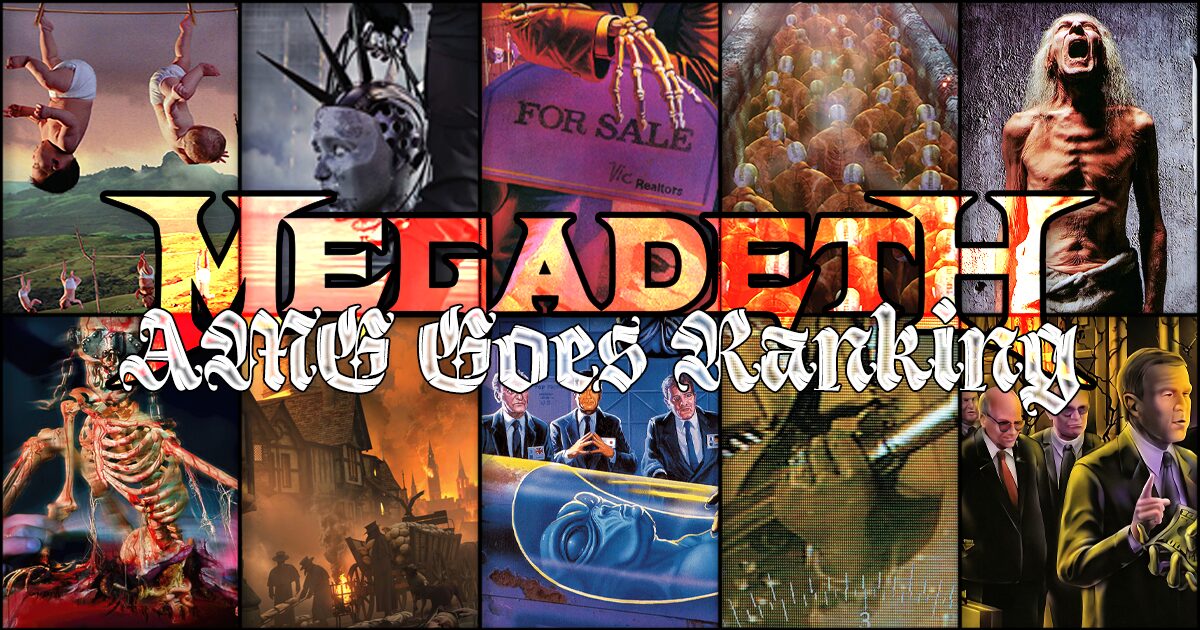
The life of the unpaid, overworked metal reviewer is not an easy one. The reviewing collective at AMG lurches from one new release to the next, errors and n00bs strewn in our wake. But what if, once in a while, the collective paused to take stock and consider the discography of those bands that shaped many a taste? What if multiple aspects of the AMG collective personality shared with the slavering masses their personal rankings of that discography, and what if the rest of the personality used a Google sheet some kind of dark magic to produce an official guide to, and an all-around definitive aggregated ranking of, that band’s entire discography? Well, if that happened, we imagine it would look something like this…
Megadeth requires no introduction, but I’ll give one anyway to provide context for why we composed an overwrought missive about one of thrash’s most enduring acts. Last year, frontman and metal legend Dave Mustaine announced Megadeth would call it quits following one last album and tour. With over forty years of metal history in the books and Megadeth’s endgame on the horizon, what better way to celebrate a storied career filled with legendary cuts and excessive ellipses than with a good ol’ fashioned ranking? Through sixteen albums, Dave and his Dethcrew have offered platters ranging from so good to so what, and we at AMG apparently have a lot to say about them.
Regardless of how you feel about Megadeth, their lasting legacy casts an immense shadow. Mustaine’s indelible footprint is evident, driving many of us writers to spend countless hours sweating bullets and overwriting about a band we love to Deth. From inauspicious beginnings in 1983,1 when Dave was famously booted from Metallica a month before recording Kill ’em All, to clawing their way into metal’s collective consciousness, Megadeth notched an extraordinary victory and became one of the most recognized bands in rock and metal. Mustaine’s influence stands tall, a monument to what a man can accomplish when he dives headlong into the lungs of hell and sets the metal world on fire with one sick lick after another. We’ll be back with a look at Megadeth’s self-titled swan song, but in the meantime, let us commence reckoning Dave and AMG’s countdown to distinction.
– Grin Reaper
The Rankings
Grin Reaper
Megadeth has been a mainstay of my diet for as long as I’ve listened to metal. I started with their greatest hits, then greedily absorbed album after album as my rapacity for thrash deepened. Leading up to Megadeth, returning to this discography gives me a new appreciation for what Dave has accomplished. Even if the lyrics can be heavy-handed and the desire for accessibility occasionally hamstrings success, Megadeth has forged some of the best thrash platters ever. For the hours I’ve spent with this music, I owe Megathanks.2
#16. Risk (1999) — I’m paraphrasing, but at some point, Mustaine said, “If Risk didn’t have Megadeth’s name on it, it would’ve sold.” Maybe,3 but it seems clear the priority was selling records and not writing great fucking metal. The doctor is calling, and he says to listen to any other Megadeth album, stat.
#15. Th1rt3en (2011) — Th1rt3en contains many of Megadeth’s core ingredients, but lacks the hooks and vitality of other releases. The album’s thirteen tracks are exhaustively padded and range from forgettable to middling. One of Megadeth’s most phoned-in albums, I rarely return to Th1rt3en outside of a full Deth play-through.
#14. Super Collider (2013) — Compared to Th1rt3en, Super Collider’s highs are higher and its lows lower. Tracks like “Kingmaker” and “Built for War” burn with a fire that rarely ignites on its predecessor, and while Super Collider’s duration is vastly improved, it only edges out Th1rt3en by the skin of its teeth.
#13. The World Needs a Hero (2001) — TWNaH might rank higher if Megadeth said goodbye to “When” and “Promises” and trimmed fat from other tracks. As is, the choruses on “Disconnect” and “Burning Bridges” nestle between Youthanasia and Cryptic Writings, which scores big points. Though not the ‘return to thrash’ advertised following Risk, it proved a crucial first step in course correction.
#12. The Sick, the Dying… and the Dead! (2022) — A step down from Dystopia, TStDatD bears some undeniable moments (including the entirety of “We’ll Be Back”) that put a high-speed hurt on your earholes. At its best, the album cranks a blistering fury that defines the immediacy Kiko brought to Megadeth. Hobbled by bloat, this could have been a better album with judicious editing.
#11. The System Has Failed (2004)4 — An irrefutable improvement on TWNaH, The System Has Failed tightened up the songwriting and injected more thrashitude than fans had seen since Youthanasia.5 Dave’s vocals are particularly strong here, and while it’s not as good as the two albums that followed, The System Has Failed is a striking improvement over Risk and TWNaH.
#10. Dystopia (2016) — Dystopia outstrips Th1rt3en and Super Collider by a country mile. While Megadeth doesn’t totally shake excess length or back-half slogs here, the opening trio of songs on Dystopia comprises the best introductory salvo since Rust in Peace.6 The rest of the album teeters between okay and very good, but “The Threat Is Real,” “Dystopia,” and “Fatal Illusion” are the most vital Deth has sounded in the 21st century.
#9. Endgame (2009) — Chris Broderick joining Megadeth set fire to the guitar leads, crafting scorching, thrashy magic on the likes of “This Day We Fight!” and “Head Crusher.” This is the most technical Megadeth has played since Marty Friedman was in the band, and the combination of six-string acrobatics, tight songwriting, and a mighty back half gives Endgame the right to be insane.
#8. United Abominations (2007) — Endgame and United Abominations are a toss-up, but UA wins out because there’s more variety from track to track, the bass slaps me silly with engaging countermelodies (“Washington Is Next!”), and there’s no “The Hardest Part of Letting Go…Sealed with a Kiss.” Plus, “Sleepwalker” is one of my favorite Megadeth tracks in the last thirty years.
#7. Cryptic Writings (1997) — Infusing all the post-grunge, alternative angst of the mid-to-late ’90s, Cryptic Writings teems with direct, catchy riffs and a vaguely dark edge. Boasting a restrained runtime, singalong choruses, and killer bass grooves, Cryptic Writings travels the popular, rock-oriented path whose biggest sin is lacking the thrash beatdown they’re so damn good at.
#6. Killing Is My Business… and Business Is Good! (1985) — Megadeth’s debut hemorrhages razor-sharp riffs in an uncontested frenzy of vitriol and venom. Unrefined and raw compared to what came later, Killing Is My Business endures as a testament to Dave Mustaine’s tenacity and vehement pledge to play better and faster than everyone else, all in an indefatigable half hour.
#5. Youthanasia (1994) — Doubling down on the streamlined songwriting from Countdown to Extinction, Youthanasia flaunts grade-A, pop-informed hookiness with metal vestiges. It also sports one of my favorite solos Megadeth wrote after 1990 in “Victory,” which encapsulates the danger of early Deth and how Mustaine’s and Friedman’s fretwork feels like it could go off the rails at any moment, but never quite does. The digestible track lengths sustain Youthanasia’s kinetic momentum throughout, even if it dips toward the end. Megadeth doesn’t recapture the aggression and destruction present on prior outings, but Youthanasia still evinces a band firing on all cylinders.
#4. So Far, So Good… So What! (1988) — I originally had SFSGSW ranked lower because of how much it’s overshadowed by the albums surrounding it. Listening with a ranking mindset and not chronologically,7 it’s apparent that Megadeth’s third album wields the unpolished vigor of their debut to greater effect. SFSGSW snatches you with barbed hooks in ear, dragging you into singalong anarchy.8 The album also contains “In My Darkest Hour,” one of the all-time great Megadeth jams. It takes the raw energy and animosity from Peace Sells and foreshadows the more progressive structures of Rust in Peace, cementing it as not only the best track on the album, but one of the best in Deth’s catalog.
#3. Countdown to Extinction (1992) — Forsaking the technical fervor of Rust in Peace, Mustaine rerouted Megadeth’s trajectory down a more commercially viable path. And though I loathe the change in direction from RiP, I can’t deny Dave’s success in creating some of the band’s most recognizable anthems while discharging the best-selling album of Megadeth’s career. “Symphony of Destruction” was the first Megadeth song I encountered, and once I dove deeper, “Skin o’ My Teeth” and “Sweating Bullets” quickly became frequent stops. Countdown remains the best fusion of Megadeth’s bethrashened roots and perennial commercial lust.
#2. Peace Sells… but Who’s Buying? (1986) — Many will tell you that Peace Sells is Megadeth’s best album. It’s not, but it’s very, very close. Maintaining the rabid ferocity of Killing Is My Business, Mustaine exercised a modicum of restraint, and instead of pumping toxic levels of riffs straight down your ear gullet, he wrote some all-time burners that expanded on the debut’s technicality without sacrificing its infectious charm. Guitar theatrics blaze through Peace Sells’ scant thirty-six minutes while the bass and drums complement serpentine axe-work with inspired grooves and rolls. In another discography, this thrashterpiece would wear the crown without challenge. Alas, Megadeth perfected technical thrash four years later…
#1. Rust in Peace (1990) — For years, Megadeth’s pièce de résistance has been my unquestioned favorite thrash metal album. Its progressive alchemy marries unfuckwithable riffs and Dave’s ever-present punky snarl, taking no prisoners and defining an iconic benchmark of the genre. When I first broke into Megadeth via their Greatest Hits, “Holy Wars…” and “Hangar 18” dominated my early listening. When I relented and bought Rust in Peace, those early listens were a revelation. I expected solid material on par with the tracks I already knew, but the quality of bangers here is unparalleled. The deep-cut status of “Tornado of Souls” and “Rust in Peace… Polaris” is criminal, but demonstrates the strength of the songwriting. Rust in Peace never relents in its cascade of squealing solos, pummeling fills, and sneer-along anthems, and there’s nary a moment that doesn’t set my head crushing banging. The apex of Megadeth’s discography is absolute perfection, and if you don’t like it, go tell it to Reader’s Digest.
Owlswald
Long tethered to Metallica’s shadow, Dave Mustaine has consistently forged music that resonates with me in some way, regardless of his antics or the era’s quality. Megadeth spearheaded my obsession with thrash and extreme metal. And although decades of lineup shifts, addiction, and health battles aimed to thwart Megadeth multiple times, Mustaine’s resilience has been steadfast. Accordingly, Megadeth is set to release their seventeenth album—a final curtain call for Mustaine to voluntarily leave the stage as metal royalty. So, to a living legend: thank you for your relentless dedication and for opening the gates of metal for me. Your legacy is secure, your throne is earned, and your place as a true titan of the genre is solidified.
#16. Risk (1999) — Essentially, “Dave tries to write hit songs,” Risk finds Mustaine still chasing a #1 record after Cryptic Writings and failing even worse the second time. Both albums serve as underwhelming final chapters for the group’s most storied era. There isn’t much else to say: Megadeth’s greatest lineup deserved a much better send-off.
#15. The World Needs a Hero (2001) — Mustaine intended for this record to fix the damage of Risk, but missed the mark completely. “1000 Times Goodbye” and “Promises” rank among Megadeth’s worst songs, squandering the potential of the “Return to Hangar” concept. Indeed, the world may still need a hero, but it certainly didn’t need this album.
#14. Th1rt3en (2011) — When the only lasting impression is Mustaine’s awful lyrics, the system has truly failed. Megadeth clearly mailed in most of this record, from the tropey “Guns, Drugs, & Money” and “We the People,” right down to its uninspired self-titled name. In short: ZZZZZZZzzzzzzzz.
#13. Super Collider (2013) — Though clearly bad, this record at least contains some semblance of the Mega juice missing from Th1rt3en. “Kingmaker,” “Beginning of Sorrow,” and “Built for War” make it memorable, for better or worse. However, the title track inexplicably finds Mustaine going full John Cougar Mellencamp, and “The Blackest Crow” sounds like the Deadliest Catch theme song.
#12. United Abominations (2007) — Despite “Sleepwalker,” “Washington Is Next!” and revisiting “A Tout Le Monde,” United Abominations falls on its face faster than you can decipher whatever the hell is going on with that artwork. Tracks like “Amerikhastan,” “Gears of War” and the title track are a mess, and Mustaine’s sermonizing rants further weigh things down.
#11. The Sick, the Dying… and the Dead! (2022) — Megadeth’s sixteenth effort leans on repetitive formulas and Mustaine’s weary vocals. Kiko Loureiro’s world-class fret-work and Dirk Verbeuren’s thundering percussion shine on tracks like “Night Stalkers,” “Sacrifice,” “Life In Hell” and “We’ll Be Back.” However, by the time “Mission to Mars” hits, bloated runtimes and awful songwriting drag things to Super Collider territory.
#10. Cryptic Writings (1997) — Chasing a #1 record, Megadeth adopted a disappointing, radio-oriented sound under producer Bud Prager. By dividing itself into thirds—one part speed, one part melody, and one part mainstream—Cryptic Writings is lackadaisical. Still, tracks like “She-Wolf,” “The Disintegrators,” and hit song “Trust” remain solid amidst an otherwise underwhelming record.
#9. Dystopia (2016) — Like Endgame, Dystopia marks a return to form with the addition of Chris Adler’s precision and Loureiro’s flair, reviving some of that classic Deth energy. Despite cringy lyrics and bloat, the record brings the goods with crunchy power chords (“Post American World,” “Fatal Illusion”), breakneck speed (“The Threat is Real”) and impressive shredding (“Conquer or Die,” “Dystopia”).
#8. So Far, So Good… So What! (1988) — Production woes, a fractured lineup, and mountains of substance abuse notwithstanding, this record somehow survived. Less aggressive and more disjointed than KIMB or Peace Sells, So Far, So Good… So What!9 still delivers some bangers with “Set the World Afire,” “Hook in Mouth” and the classic “In My Darkest Hour.”
#7. The System Has Failed (2004) — This album is a crucial recovery from the Risk era. Chris Poland’s return and the addition of session drummer Vinnie Colaiuta provide a massive lift, compensating for muted production and a sluggish mid-section. “Kick the Chair” drives the record, offering essential proof of life and showcasing Mustaine’s resilience.
#6. Endgame (2009) — Megadeth recaptures their golden-era speed and calculated aggression through heavier, more technical songwriting. While tracks like “Bite the Hand” showcase classic riffcraft, guitarist Chris Broderick is the true catalyst—his insane solos and leads elevate the entire record. Despite minor stumbles like “The Hardest Part of Letting Go,” Endgame proved Megadeth still had it.
#5. Killing Is My Business… and Business Is Good! (1985) — More than a mere middle finger to Metallica, this debut is pure vitriol and velocity. From the breakneck pace of “Mechanix” to the straight-up thrash assault of “The Skull Beneath the Skin,” this record introduced Megadeth to the metal world and forged their identity with fire. A rhythm section unlike any other at the time anchored Mustaine’s venomous vocals and Poland’s unorthodox leads. Samuelson’s jazz-infused sensibilities and Ellefson’s precision formed a lethal engine, providing the framework for Mustaine and Poland to unleash their frantic guitar fury overhead. Beyond its raw aggression, KIMB served as a dress rehearsal for the creative pinnacle that would soon follow.
#4. Youthanasia (1994) — Hanging babies! This record captures Megadeth at the height of their mainstream powers, delivering a record that is more vocally driven than its predecessors. Mustaine offers arguably his finest vocal performance here, showcasing a resonant range that outshines even Countdown to Extinction. From the chugging pick-scrapes of the groovy “Train of Consequences” to the vulnerable “A Tout Le Monde,” though the songwriting on Youthanasia feels more calculated, controlled, and melodic, the album still retains its bite. Nick Menza’s drums hit like artillery fire, particularly on tracks like “Black Curtains,” “Youthanasia,” and “Reckoning Day.” It’s Megadeth riding on popularity without losing their edge.
#3. Countdown to Extinction (1992) — Countdown to Extinction marked Megadeth’s definitive arrival as a commercial powerhouse. It introduced a polished, but still high-octane sound filled with purpose and precision that left almost all others in their deathly wake. Boasting a wealth of riffs, sophisticated lead work, Menza’s monumental drumming, and a vibrant production that gives everything an in-your-face presence, Countdown is essential Megadeth. Though it famously debuted at #2 on the charts—stymied only by another now-famous black album—tracks like the legendary “Symphony of Destruction” and “Sweating Bullets,” “Foreclosure of a Dream” and my personal favorite, “Architecture of Aggression,” prove why this record launched Megadeth into the stratosphere.
#2. Rust in Peace (1990) — What more can anyone say about this record that hasn’t already been shouted from the rafters? As the most heralded record in the Megadeth discography, Rust in Peace debuted the best lineup, fully established their now iconic sound, and ignited an incredible multi-album hot streak. Admittedly, I arrived at the Rust in Peace party late—discovering this masterpiece only after Countdown to Extinction had dropped. But it’s also cool to be fashionably late, right? Aside from the cheesy “Dawn Patrol,” this record is nothing less than a classic, proving why Megadeth earned their spot atop the thrash hierarchy.
#1. Peace Sells… but Who’s Buying? (1986) — Speaking of classics, this was my gateway into Megadeth and the wider world of thrash metal. On a local record store recommendation,10 I picked up the tape, and once Samuelson’s drum roll kicked off “Wake Up Dead,” that was all she wrote. Peace Sells… but Who’s Buying? is a masterclass in aggression and technicality. While “Wake Up Dead,” the title track and “The Conjuring” are popular classics, it’s the darker, complex depths of “Bad Omen,” “Devil’s Island” and “Good Mourning / Black Friday” that define the record’s soul. The musical evolution from their debut to this is nothing short of astonishing. Most point to Rust in Peace as the pinnacle, but for me, this will forever be the definitive Megadeth record. It’s home to some of the most legendary, headbangable riffs ever written and is the ultimate Deth experience.
Baguette of Bodom
With great ’80s thrashing comes great ’90s blunders, unless you’re Testament. MEGADAVE’s long history contains many missteps, and the incessant obsession with remixing everything 17 times made this younger metalhead’s introductory experience needlessly confusing years ago. That being said, the highs are very high indeed, and I love talking veteran bands without any nostalgia goggles. For this ranking, I’m taking my favorite (and hence, most familiar) version of each album into account, usually indicated by the cover art. Though many of the originals are a must, there are notable exceptions.11 Lists sell… but who’s buying?
#16. The World Needs a Hero (2001) – Nothing says ‘thrash comeback’ like sly, edgy ’00s breakup songs at 50 BPM. Infinitely worse than their rock misadventures ever were, the stretch from “1000 Times Goodbye” to alt-metal ballad “Promises” should be considered a war crime. At least “Return to Hangar” apes a good Megadeth track.
#15. Super Collider (2013) — I don’t know what possessed Dave to reattempt the Risk method, but it went even worse for him this time. There are a couple of okay tracks here (“Kingmaker,” “Built for War”), but as a whole, the album just comes off as bafflingly tone-deaf and humorously weak.
#14. The Sick, the Dying… and the Dead! (2022) — Holy cow, what a massive disappointment. I thought they were getting somewhere again with Dystopia, and then they fell right back below sea level. The title track and the fun “Mission to Mars” are salvageable, otherwise it’s a bloated monstrosity full of mediocre to bad re-thrash.
#13. Risk (1999) — Even having Risk this high might invoke threats of mob violence. Cuts like embarrassing arena wannabe “Crush ‘Em” make Risk comically lame, but some are decent and catchy (“Wanderlust,” “I’ll Be There”). Not a good record by any means, but Megadave is capable of worse than boring.
#12. United Abominations (2007) — A good four-track EP (especially “Washington Is Next!”) held hostage by the seven lame tracks that follow, not to mention “À Tout le Monde (Set Me Free)” being offensive to the original Youthanasia gem. Not an abomination, but still corny and mediocre.
#11. So Far, So Good… So What! (1988) — When discussing Megadeth’s ‘first four,’ SFSGSW is usually spoken of under breath, if mentioned at all. And for good reason: it’s angsty, gimmicky, and “Anarchy in the U.K.” is a Thing That Should Not Be. However, the all-time great “In My Darkest Hour” justifies the existence of the entire album.12
#10. Cryptic Writings (1997) — Overhated! It’s bloated with annoying radio filler, but also contains some strong, catchy tunes with a great sense of both melody and groove (“Trust,” “A Secret Place”). Crown jewel “She-Wolf” is a discography highlight, and the closest Megadave ever got to Iron Maiden.13
#9. Th1rt3en (2011) — Aside from the terribad name, Thirteen14 is also way overhated. It’s a bit too long and I don’t spin it regularly, but it’s a consistently solid record from a band that often struggles with consistency. Basically a slower Endgame/Dystopia, with good fun tracks like “Fast Lane” and “Wrecker.”15
#8. Dystopia (2016) — I’ve cooled on this album, but it’s still one of their better current-millennium records. Not that there’s a whole lot of competition! The instrumental “Conquer or Die!” is very fun in particular, but it’s good thrash all around, with more energy and stronger highlights than Thirteen. Worse vocals, though.
#7. Countdown to Extinction (1992) — A strong transitional record, even if somewhat overrated. Gimmicks (“Psychotron,” “Captive Honour”) and oversimplified guitar work set it back somewhat, but the highlights are great. The title track is one of Megadeth’s finest moments, and “Ashes in Your Mouth” deserves more praise, too.
#6. Endgame (2009) — This is commonly regarded as the best post-1990 ‘Deth, and I totally see why. It’s a powerful, aggressive, energetic record, almost front to back, with even shredtastic intro gem “Dialectic Chaos” somehow being a highlight. However, there are other albums that I think do more with higher peaks.
#5. The System Has Failed (2004) — Severely underrated! The songwriting is heavy, catchy, and creative all at the same time, in a way it hasn’t been ever since, and everything from “Die Dead Enough” to “Back in the Day” is an earworm. This album sees the brief comeback of Chris Poland, guitarist on KIMB and Peace Sells, and he’s still got it here. Drummer Vinnie Colaiuta (Frank Zappa, Joe Satriani) also brings in that crucial outside influence that often results in great albums. I could leave “Something That I’m Not” and the strange dual outro-ish last two tracks off, but they’re alright as is.
#4. Killing Is My Business… and Business Is Good! (1985) — An endlessly fun, blazing fast, wild, and free set of bangers by a pissed-off young Dave and co. How could anyone resist “The Skull Beneath the Skin” or “Mechanix?” Though the original $0 budget mix of the album (not easily available outside of YouTube) is limp and occasionally harms the listening experience, the 2002 mix pictured here is fortunately great and largely fixes its issues. That being said, the original uncensored version of “These Boots” is much preferable—but the re-recorded and censored one on reissues is really funny in its own way.
#3. Youthanasia (1994) — Much like The Ritual was Testament’s way of showing the world you can ‘sell out’ and still make great music,16 Youthanasia managed to do the same to Megadeth’s already Countdown-diluted sound. Except this is a direct upgrade to Countdown. An infectiously catchy album front to back, loaded with great tunes while still featuring strong guitar work and clever songwriting by Marty and Dave. The back half deserves more recognition for its excellencies: “Family Tree,” “Blood of Heroes,” and song title reference extravaganza “Victory” to boot. I’d maybe only drop the title track, funnily enough.
#2. Peace Sells… but Who’s Buying? (1986) — Despite my accidentally remix-fueled lukewarm first impression,17 the original version soon found its way through my ears into my heart and never left. Maybe part of its magic is the jazz fusion background of Chris Poland and drummer Gar Samuelsson being more prominent, or the gang blowing a little less money on drugs, or both. Regardless, Peace Sells is a special little bottle of lightning, relentless yet intelligent, and massively hook-laden. “I Ain’t Superstitious” is the only slight drawback, but “My Last Words” makes you forget it by dishing out some of the best guitar work in the genre.
#1. Rust in Peace (1990) — What is there left to say about a stone-cold classic and nigh-perfect album that hasn’t already been said? Controversially, I prefer the 2004 remix for its drum sound,18 but Rust would take the crown either way. An album that starts with “Holy Wars… The Punishment Due” and ends in “Rust in Peace… Polaris” is already an absolute monster, and the rest of the track list is equally fantastic19 only further cements its status as an all-timer. This is the album that introduced drummer Nick Menza and guitarist Marty Friedman to the wider metal world, and the music is all the richer for it. Thunderous rhythm and lead guitar work, legendary solo craft, complex yet catchy barn-burners—it’s all here. Rust in Peace is not just a cornerstone of thrash metal; it’s also a hallmark of progressive metal.
Andy-War-Hall
I remember when Pandora radio first put Megadeth’s “Skin O’ My Teeth” my way, exposing an impressionable teenage Andy to thrash metal for the very first time. At once, I grew angrier, my IQ plummeted substantially, and my chances at female companionship dropped to NY Jets Super Bowl probabilities. I wouldn’t trade it for anything. Megadeth is a household name of heavy metal for a reason, and their discography has shaped the genre forever. To the kings of Too Much—whether it be notes-per-riff, ellipses-per-title, or time scrolling Facebook conspiracy theory rabbit holes—we salute thee!
#16. Risk (1999) — Risk is—to borrow the closing line of “Take No Prisoners”—”shit.” Every choice in Risk attempts to ride the already-tired waves of alt-rock and arena country. Worse yet, none of it sounds good at all. To quote “Good Mourning/Black Friday”—”What the fuck is this?”
#15. Super Collider (2013) — You know your album is in dire straits when you gotta tap Disturbed’s David Draiman for songwriting help. Just barely not Megadeth’s worst album, Super Collider feels the most exasperating. Butt-rock banality infects every nook and cranny, presenting Megadeth as a band thoroughly out of steam. Nuts.
#14. The World Needs a Hero (2001) — Bouncing back from Risk was never going to be easy. This isn’t a bounce back. If not for “Dread and the Fugitive Mind” or the deeply ironic enjoyment I derive from “1000 Times Goodbye,” TWNaH could easily have slipped to the bottom of this list for its shallowness alone.
#13. Th1rt3en (2011) — This straight up pisses me off that I got Th1rt3en at #13. It feels like I let Dave win. It being here has the same air of pretense as Mustaine’s decision to make Th1rt3en thirteen tracks long. There are perhaps five acceptable ones.
#12. Cryptic Writings (1997) — You know, I actually had a bit of fun with my last spin of Cryptic Writings. It stinks, but don’t let the Motörhead beligerence of “The Disintegrators,” the Maidenesque harmonies of “She-Wolf” or the pure thrash bonanza of “FFF” be forgotten amongst the bad of Cryptic Writings.
#11. United Abominations (2007) — If Mustaine wasn’t so utterly miserable all the time, United Abominations could’ve been awesome. The grooves and solos are real, but not one of you can tell me that the rants on “United Abominations” or “Amerikhastan” make the music better. Turn off the TV, Dave. Take a deep breath.
#10. The Sick, the Dying… and the Dead! (2022) — Megadeth engenders strong opinions. Love ’em or hate ’em, you either love ’em or hate ’em. I have no strong feelings towards The Sick… I chuckle at the “Bring out yer dead!” sampling in the title track. I wince at Ice-T’s narration on “Night Stalkers.” Beyond that, it’s fine.
#9. So Far, So Good… So What! (1988) — The roughest, crustiest of Megadeth’s early material, So Far… feels like a band caught in limbo, embodying neither the piss-and-vinegar of KIMB nor the sophistication of Rust in Peace. But it’s still plenty fun, particularly with the closing three tracks. It’s like Peace Sells after a few beers.
#8. Youthanasia (1994) — The faintest odors of the enshittification of Megadeth can be smelt at times, particularly in its more rock-driven moments, but Youthanasia is nonetheless a killer send-off record to Deth’s best lineup. I used “Reckoning Day” in a short story I wrote in college one time. It was bad.
#7. Dystopia (2016) — When I heard “Fatal Illusion”‘s bitchin’ bass line in high school, I entered a fugue state and woke up with a Dystopia t-shirt from Hot Topic. I was pleasantly surprised to find that the rest of the album was also mostly good, if a bit slow at times.
#6. The System Has Failed (2004) — Why does nobody talk about The System Has Failed? After Megadeth’s most miserable stretch of albums, bangers like “Blackmail the Universe” and “Kick the Chair” soar in purest triumph. Some slight duds here and there keep it down, but if you’ve slept on The System then correct that at once!
#5. Endgame (2009) — Where Mustaine and co. found the spark that set Endgame ablaze so late in their career is a mystery to me, but boy am I glad they found it! Endgame is erupting flatulent with adrenaline-rushed barn burners like “Headcrusher,” “This Day We Fight!” and “1,320′,” and Megadeth sounds almost as volatile as they did on Killing Is My Business… with Chris Broderick’s gob-smacking guitar solos. If not for the out-of-place balladry of “The Hardest Part of Letting Go…Sealed with a Kiss,” this could’ve been a top-three contender. Shred ’til yer ded!
#4. Peace Sells… but Who’s Buying? (1986) — The album that set Megadeth on the course towards fancier, more adventurous waves, Peace Sells… feels like the record Mustaine wanted to write but needed to vent with Killing Is My Business… first. From nasty bruisers like “Wake Up Dead” and “Devil’s Island” to dramatically-bent cuts like “The Conjuring” and “Good Mourning/Black Friday” to Mustaine’s first awkward steps into political commentary on “Peace Sells,” the Megadeth we know today truly began with this record. To put it simply, stupid, Peace Sells… is a huge part of what made ’86 the year for thrash metal.
#3. Countdown to Extinction (1992) — Do you understand just how incredibly slick Countdown to Extinction is? Yeah, it’s a long step back technically from Rust in Peace, but with that stripping down in chops came sharpness, and songs like “Skin O’ My Teeth,” “Architecture of Aggression” and “High Speed Dirt” are lean, mean and sharp, indeed. Countdown sees Megadeth at their absolute hookiest, with “Symphony of Destruction,” “Sweating Bullets” and “Foreclosure of a Dream” digging deeper into my gray matter than any of their bids for radio play ever could. If not for some bloat at the end, Countdown could’ve threatened the top spot.20
#2. Killing Is My Business… and Business Is Good! (1985) — The Megadeth we all know began with Peace Sells… but Killing Is My Business… is just Dave Mustaine doing what Dave Mustaine does best: playing way too many notes way too fast and way too mad. And I love it. These riffs are just stupid in the best way, imbuing “Looking Down the Cross,” “Rattlehead” and “Mechanix” with so much spite and hostility it’s stupefying. While most pre-extreme metal records that once terrified parents now come off as a bit toothless, Killing Is My Business…, while still kinda silly, sounds dangerous in 2026.
#1. Rust in Peace (1990) — I like Megadeth. Hopefully, that came across after all of this. But for every album of theirs, even the good ones, there’s usually one or two questionable aspects or a dud song that keep them from being essential. Rust in Peace, however, is as totally essential as an album can be. Manned by Megadeth’s greatest lineup in Mustaine, Ellefson, Menza and Friedman, Rust in Peace is a heavy metal masterclass and an unquestionable classic. A marvelous artistic achievement that’s as technical (“Lucretia”) as it is emotional (“Tornado of Souls”) as it is dreadful (“Holy Wars…The Punishment Due”) as it is fun (“Take No Prisoners”), Rust in Peace is the kind of masterpiece only Dave Mustaine and his complete unwillingness to restrain himself could create. Proving that “Less Is More” is the greatest scam of our age, Rust In Peace is Megadeth’s magnum opus and you’d better believe it!
Tyme
As contentious as it’s been at times, I wouldn’t want to live in a universe where Metallica never kicked Dave Mustaine to the curb. The fact that two of the greatest thrash metal bands of all time sprouted from that split inarguably supports that statement. Despite his ups and downs and propensity for assholeish shenanigans, I’ve always been a Dave fan. As we seem to have reached a time when he’s poised to walk away from music on his terms, I’d be lying if I said I’m not a little verklempt about it. Megadeth has been a massive part of my metal upbringing, and I’ll always be thankful for the music that’ll be left behind. Well, maybe not all of it, this is a ranking post after all.
#16. Super Collider (2013) — Especially disappointing since I’d hoped Megadeth’s Risk years were safely behind them. From the cringe-inducing lyrics and tired, played-out riffs to the ridiculously boring, Vic-free cover, Super Collider is insipidly weak. It sits at the bottom of my barrel as a testament to Dave’s riskily unlearned lesson.
#15. Risk (1999) — Intentional or not, Risk was definitely that, a radio-rock debacle that more than earned its spot here. This album had always been Dave’s longest-standing turd for me, at least until 2013. My second listen, endured solely for this ranking, did nothing to change that opinion.
#14. The World Needs a Hero (2001) — Outside of “Return to Hangar,” which is a decent song even if it’s offensively cheesy, I had never listened to TWNaH completely. Megadeth-lite had entirely moved off my radar after Risk, so I never even thought about giving this a spin in 2001, or any other year until now. Thrash.
#13. Th1rt3en (2011) — Beyond the uber-cheesy, ridiculously juvenile ’13’ puns, there were a few rays of promise on this mostly bloated platter (“Sudden Death,” “Black Swan,” and “13”). Not even Dave Ellefson’s return could elevate the album from its inherent mediocrity, though—the last body in the sub-basement of Megadeth’s discog.
#12. United Abominations (2007) — I saw Megadeth live for the first time during 06’s Gigantour, where I picked up a nifty autographed print of United Abominations’ cover art. This album is mid-tier Megadeth, and while a few diamonds exist, it takes some weed-whacking through the rough to find them.
#11. Cryptic Writings (1997) — Tolerably catchy, Cryptic Writings was a definite precursor to Megadeth’s dark years (1998 – 2003). Still, there’s a handful of tracks here I return to on the regular. For me, Cryptic Writings marked the end of the most successful run of Megadeth’s existence.
#10. Endgame (2009) — By far one of the better records to come from the second half of Megadeth’s career, Endgame is full of crispy riffs and Dave’s trademark snarls. It is by far the best album recorded by the Broderick, LoMenzo, Drover line-up, even though I don’t return to it very often.
#9. Dystopia (2016) — Sporting one of my favorite Megadeth covers, Dystopia brings the riffs in droves. Kiko Loureiro’s guitar mastery and Chris Adler’s drum magic elevate the material, even bolstering Ellefson’s performance, who sounds satisfyingly rejuvenated. My biggest nit is that almost every track has an annoying fade-in.
#8. The Sick, the Dying… and the Dead! (2022) — With the return of the mighty Megadethian ellipsis, and the addition of Steve DiGiorgio and Dirk Verbeuren, TS,tD… atD blew me away, coming out swinging way harder than it had any right to. Unequivocally, my favorite thing Megadeth has done in nearly two decades as of this ranking. Let the beatings commence.
#7. The System Has Failed (2004) — After disbanding due to injury, it was encouraging to hear Dave had recovered and, despite my trepidation, was going to release a solo record.21 I was, however, beyond stoked to see the Rattlehead-adorned, Megadeth-monikered TSHF drop, which was light years better than I anticipated, with keenly satisfying melodies and some of Dave’s best vocals.22
#6. Youthanasia (1994) — As an old-head Megadeth fan, the more melodic direction raised some concerns, but Youthanasia is one of the best-sounding albums in the band’s discography. That first warm and crunchy riff on “Reckoning Day” still works wonders, while “À Tout le Monde,” albeit overwrought, rocks and could only have been pulled off by Dave. Oui oui.
#5. So Far, So Good… So What! (1988) — My appreciation for SF, SG… SW! did not manifest until later in my metal life. I mean, any album was going to struggle to meet the high bar set by Peace Sells, but the thin production and, what I perceived as lackluster songs, aside from the most excellent “In My Darkest Hour,” just didn’t land with me. In time, though, I came to love this little gem, from the album’s lethal opening one-two punch to the last couple uppercuts (“Liar,” “Hook In Mouth”). It’s the weakest of Megadeth’s first four outings, to be sure, but it’s still a classic and sits deservingly at my number five.
#4. Countdown to Extinction (1992) — Countdown to Extinction is a muther fuckin’ CRUNCH fest. With its surgically precise production, every riff, lick, lead, bass line, and snare strike sounds crystal clear, putting the album in a sonic category all its own. Yes, it was a more rock-forward affair and a departure from the classic thrash assault Megadeth had become known for, but I love every minute of it. Countdown holds some of my favorite deep cuts (“This Was My Life,” “Psychotron,” “Ashes in Your Mouth”) and, despite its uber-popularity, “Symphony of Destruction” is still a pulse pounder.
#3. Killing Is My Business… and Business Is Good! (1985) — When Bach’s Toccata and Fugue in D Minor came wafting out of my speakers for the first time, it hooked me. Every acidic drop of Dave’s piss and vinegar attitude pours out of each minute on Killing, his vocal performance brilliantly unhinged. Of the Big Four debuts, Killing Is My Business stands as the rawest and most eclectic, full of lightning-fast riffs and jazzy, blues-tinged melodies. Ellefson’s performance, especially, is a delight for me, ebullient and Maideningly noodling, it stands as the best of his Megadeth career. And by the time I made it to the jet-fueled funny car speed of “Mechanix,” I was fascinated by how fast “The Four Horsemen” could be played.
#2. Rust in Peace (1990) — Technically proficient, polished, and magnificently executed, Rust in Peace is one of the largest jewels in Megadeth’s crown. In fact, there’s not a track on this, or on either of the other two excellent Megaplatters wedged above and below it on this list, that compels me to reach for the skip button, bangers all. A guitar-lover’s absolute wet dream, Friedman and Mustaine combine to turn in the shreddingest performance of any Megadeth release bar none. And though the Friedman, Ellefson, Menza iteration of the band would never surpass the excellence on offer here, they never needed to—Megadeth perfection.
#1. Peace Sells… but Who’s Buying? (1986) — If the 80s were the golden age of thrash, 1986 was the platinum year of that age—each of the Big Four releasing, for me at least, the best albums of their careers.23 Peace Sells took the unhinged craziness of Killing and honed it to a razor’s edge, while still retaining a rawness that, for me, perfectly embodies the classic sound of thrash metal. Coming of age at a time when MTV was still playing music videos, I spent countless nights riveted to the screen watching Headbanger’s Ball, and no video got my blood pumping more than “Peace Sells… but Who’s Buying?” It’s my favorite Megadeth song to this day, and that harmonized breakdown mid-song still gives me goosebumps. From the brilliantly rendered Ed Repka cover art, whose work became synonymous with the genre, to the thirty-six minutes of utter thrash metal bliss, Peace Sells has been and will always be my number one.
MegaDolph
I’ve been listening to Megadeth for almost as long as I’ve been listening to metal, as classic NWOBHM and shred led me straight down a path to thrash. With a perpetual chip on his shoulder and a voice suited for little beyond punkish and sneering music, Dave Mustaine cemented his brand of all-fury riffcraft and roll-the-dice band selection into my listening history, even if his own history with Megadeth has near as many flaws as it does adornments. And so, in the spirit that Mustaine would harbor, I’m pulling no punches and delivering my mostly agreeable stances on Megadeth with tact and brevity. And that leads us straight to…
The Bad: The bottom can be entertaining in some discographies, but when #16 Risk (1999) holds the floor, you get tepid alt-rock sung by a guy who should be doing something else. Likewise, when #15 The World Needs a Hero (2001) stands above it in its “Dave writes songs about being angry at women” glory, and when Dave wastes the screeching talents of Al Pitrelli (Savatage, Trans-Siberian Orchestra), little better awaits you. I wish I could say that #14 Super Collider (2013) raised the bar, but in a similar fashion to its rung below, Chris Broderick might as well have had his guitar credits removed cause Dave went to great lengths to focus on anything but what Broderick could add to Dave revisiting sloggy blues rock with the occasional thrash riff. #13 Cryptic Writings (1997) marks the first improvement on this grueling path to the good stuff, if only because a few songs continue the playful-but-not-really-thrash energy of early ’90s Deth. #12 The Sick, the Dying… and the Dead! (2022) sees Dave pulling the same old tricks in hiring legendary bassist Steve DiGiorgio (Quadvium, Testament) just for him to be part of the album’s absent low-end; however, Kiko Loureiro (ex-Angra), at least, bolsters this walking speed collection with sick solos. In many ways, #11 Endgame (2009) was the same album, a little more than a decade earlier, but with Chris Broderick being the additional fretboard fire—I wish those flames had burned “The Hardest Part of Letting Go… Sealed with a Kiss” to ashes. But, as we move to the top 10 of Megadeth’s career, things truly do get better.
#10. Th1rt3en (2011) — Though a cut above the most disposable of Megadeth’s works—and host to their worst album name by a wide margin—Dave wears his last effective snarl in the Megadeth chronology and manages to use Broderick in smart ways against his punky/blues rock attitude.
#9. Dystopia (2016) — Much like the album that comes after it (The Sick, the Dying… and the Dead!), its breezy cadence makes for a low enthusiasm experience, but one with Kiko Loureiro, again, stealing the show when he’s allowed to flex—he’s even given one full song to himself to do it (“Conquer or Die”)!
#8. Youthanasia (1994) — Though already halfway to the sound they’d explore later in the ’90s, Megadeth still thinks they’re a groovy metal band for most (sans the ballads, yuck) of Youthanasia, which goes a long way with the classic Menza-Ellefson rhythm section and Friedman solo magic.
#7. United Abominations (2007) — The Drover brothers harbor the tightest rhythm-lead interplay on UA since Youthanasia while Dave drags it down all the way to the 7-spot by filling about 71% of this album with drunk uncle ranting and radio-filtered “samples.”
#6.Countdown to Extinction (1992) — Hot off the heels of Rust in Peace, this step backwards in composition functions a lot like the step backwards that So Far, So Good… So What! delivered, except that about half the songs disappear under the weight of its best cuts.
#5. So Far, So Good… So What! (1988) — A lot of people, even my colleagues, I’m sure, will call half this album filler or unadvisable, but I call it Dave having a blast with one-time second guitarist Jeff Young, littering pinchy, wailing, neoclassical lead work over punchy, punky, small club thrash.24
#4. The System Has Failed (2004) — System possesses an ambition in Megadeth returning to thrash, Poland returning to melting faces, and Dave creating big studio arrangements around riffed out hooks and his classic snarky diatribes—balance and power.
#3. Killing Is My Business… and Business Is Good! (1985) — Megadeth sounds like they could fall apart at any moment of Killing’s reckless 6-string mania, but they never do despite having blown most of their production budget on performance-enhancing substances.
#2. Rust in Peace (1990) — Megadeth captured Marty Friedman in his metal-related creative peak, which makes for some of the most iconic thrash solos that elevate simpler cuts—most of Rust is quite technical and progressive for an American thrash band like at that time—like “Take No Prisoners” and “Poison Was the Cure” to rager status.
#1. Peace Sells… But Who’s Buying? (1986) — Bass-forward, fretboard gymnastics-loaded, and crowd-ready in its aggressive thrash platform, Peace Sells stands the test of time in every riff, in every spiteful Dave spitting, and every sweat stain of pure mosh energy.
Angry Metal Guy Staff Ranking
We’ve once again used our tallying magic to use a complex point system based on submitted rankings.
Risk (1999)
Super Collider (2013)
The World Needs a Hero (2001)
Th1rt3en (2011)
The Sick, the Dying… and the Dead! (2022)
Cryptic Writings (1997)
United Abominations (2007)
Dystopia (2016)
Endgame (2009)
So Far, So Good… So What! (1988)
The System Has Failed (2004)
Youthanasia (1994)
Countdown to Extinction (1992)
Killing Is My Business… and Business Is Good! (1985)
Peace Sells… but Who’s Buying? (1986)
Rust in Peace (1990)
Angry Metal Discord Pile o’ Entitled Opinions
We did the same thing for our Discord users. Their opinions smell almost as bad as they do. But they have strong opinions about Dave and his rotating cast of thrashy miscreants. There’s no way they got it more right though… right? But you asked for more lists25
Super Collider (2013)
The World Needs a Hero (2001)
Risk (1999)
The Sick, the Dying… and the Dead! (2022)
Th1rt3en (2011)
United Abominations (2007)
Cryptic Writings (1997)
Dystopia (2016)
The System Has Failed (2004)
Youthanasia (1994)
Endgame (2009)
So Far, So Good… So What! (1988)
Countdown to Extinction (1992)
Killing Is My Business… and Business Is Good! (1985)
Peace Sells… but Who’s Buying? (1986)
Rust in Peace (1990)
Given the wide reach Megadeth’s music has, we thought it would be a good exercise to highlight some of Deth’s lesser-known tracks to let casual listeners know what they’ve been missing.
The post AMG Goes Ranking – Megadeth appeared first on Angry Metal Guy.