
It’s not as well-known as Clair Obscur or Hollow Knight, but one of our favourite indie games of last year was Skate Story. Released in December, developer Sam Eng’s psychedelic skateboarding sim is set amid a smoky urban underworld inhabited by demons. Think Tony Hawk’s filtered through a hallucinogenic concrete nightmare – and soundtracked by one of the coolest gaming albums in ages. Seriously, the music absolutely slaps.
Read more: How Tony Hawk’s ‘Pro Skater’ soundtracks are fuelling a Gen Z skate revival
It’s made up of two complimentary halves. One side, composed by John Fio for Skate Story’s reflective free-roam moments, is an atmospheric blend of twinkling synths, shimmering guitars and soothing saxophones. The other, by New Jersey electro group Blood Cultures, adds massive danceable bangers to the exciting chase sequences and show-stopping boss battles. We’re talking euphoric pop hooks, ambient electronica, blasts of choppy punk and hip-hop-flavoured beats. Both volumes make up Skate Story’s immersive soundscape, but the latter elevates its defining moments – and is likely what you’ll return to most once the credits have rolled.
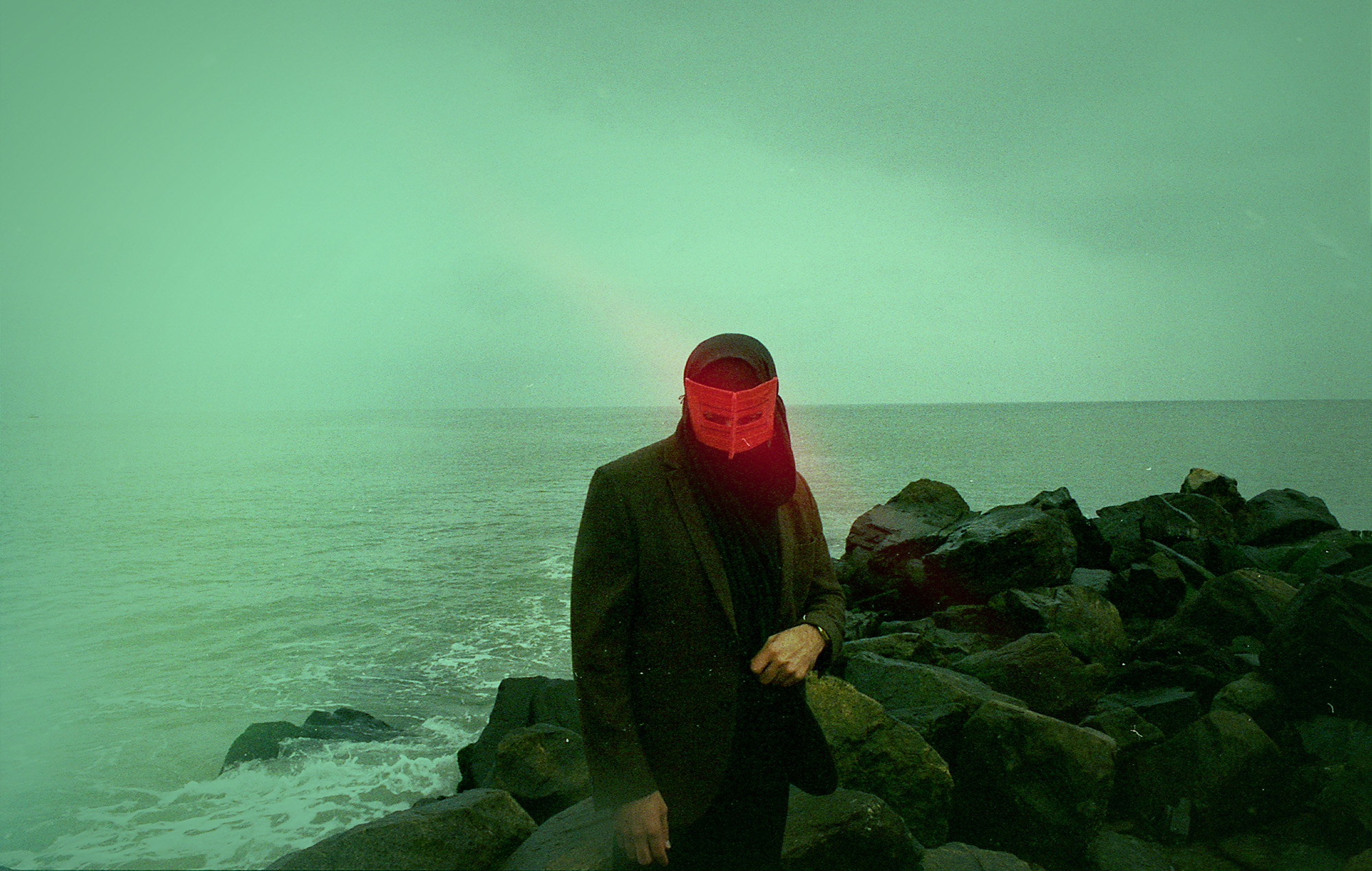
To learn a bit more about the tracks, we caught up with Blood Cultures via Zoom. We’d first heard about the dark, brooding electropoppers nearly 10 years ago, but they’ve been active since 2013 – first as a solo project and then as an anonymous collective who wear masks to hide their identities. This means that when we spoke with the group’s founder member, it was strictly audio-only.
One of the first things they told us was that Blood Cultures’ impact on Skate Story actually goes back to its conceptual genesis. Eng, a fellow East Coaster, tapped them up in 2019 after listening to their first two albums. “[Eng] told me about the concepts the first time we met,” they tell NME. “He had a skateboard with him, so I knew he was legit right away. He told me how he was inspired by skating around New York City listening to our music. So the original ideas for the game came from that experience.”
Zelda was a surprising influence
Any musical associations with skateboarding games immediately bring to mind the licensed post-punk rock compendiums of Tony Hawk’s Pro Skater, but the narrative emphasis in Skate Story allowed Blood Cultures to deviate from any obvious riffs.
“When you think of skating games, you think of Tony Hawk’s, and that was what came to mind up front,” they tell NME about the early discussions. “The first impression that I had was: we can make a punk record or a hip-hop record – and we obviously didn’t do either of those things.” This view changed when Eng described the narrative as the “strongest character” in Skate Story. “What came to mind when he was telling me about all these environments and characters, was more something like [‘90s action-adventure classic] The Legend Of Zelda: Ocarina Of Time,” where the music is “a lot more intentional and based on moments” versus “just having a radio”.
“That was really exciting for me,” they add. “I thought, ‘OK, cool. I’m not recreating Tony Hawk’s. I’m not recreating skate. or whatever. We’re going to do something completely our own that is more inspired by these other games.’”
‘Skate Story’. CREDIT: Devolver Digital
New York’s influence runs deep
Eng gave Blood Cultures “complete freedom” to create tracks how they pleased, based on the game’s Big Apple-inspired aesthetics. “Just looking at [Skate Story], you can tell there’s something ethereal about it, so that was something that I wanted to create in the music,” they say, “being a little spacey and otherworldly, but still having this tactile texture to it.”
The implementation of sounds taken directly from the city afforded the album this lived-in quality. “I went around New York City with a field recorder and a drumstick, and I recorded different sounds. Sometimes it was just pigeons in the park, or being the only person standing in Grand Central Station and letting a bunch of people pass by, or the sounds of the subway. That developed into this library of samples that I procured just by trying to absorb what New York sounds like.”
From there, the challenge was converting this catalogue into something you’d want to listen to. They asked themselves: “Sonically, how does this integrate into this world?” What they eventually strived to capture was a hazy reflection of the Big Apple. “The idea was to make it feel like a dream, so not New York City, but like a memory of New York City – like a dream that you were there once.”
‘Skate Story’. CREDIT: Devolver Digital
A skateboarding injury set them back
Their back-and-forth collaboration spanned the game’s development, which was delayed by an injury Eng endured partway through – a broken arm from skateboarding in NYC. For a game that uses the inevitable injuries and falls from the sport as an overarching metaphor for life itself, the irony is obvious.
The two parties exchanged songs, level designs, characters and sequences from the game to help assemble ideas for the soundtrack. However, Eng’s curation of the songs in the game, and where they are specifically placed, was something Blood Cultures wanted to credit.
“I think [Eng’s] instincts were very strong and proved to create an amazing narrative that, when you play the game, you can hear and see. He did tell me we needed more boss battle music though,” they laugh. “So that’s why there’s more intense songs on this [album].”
Blood Cultures. CREDIT: Jaafar Alnabi
The limitations made it different to their previous albums
‘Skate Story: Vol. 1’ was designed as a standalone record but the experience of making it was still “pretty different” to Blood Cultures’ prior albums. “We already had a sandbox to play in and something to develop from,” they explain. “Rather than having infinite choices and infinite tools to do infinite things, it was a lot more limited – and I think any creative person can tell you that you find creativity in your limitations.”
Blood Cultures describe the record’s core idea as “grounded in motion”. They challenged themselves to define the sound of New York, where they live. As such, it could be interpreted as a personal album – but as an anonymous collective who don’t want their backgrounds impeding the narrative of the music, it’s not something they’re shouting about. Indeed, one of the only things we know about the band’s founder is their Pakistani-American heritage.
“I’ve felt like I’ve had to share some information [about our background] so that you can have [an] understanding of the perspective of the music. But ultimately, I don’t think you need that information. That information is… if you want to engage in and get a deeper relationship with the artwork itself.”
Can you separate the art from the artist though? “I personally do not believe you can,” they say. “We’ve always been very limited about what we share, because we want whatever we share to impact the art in a way that it brings the listener closer to the music.
“I think as musicians or artists, your job is to tap into a frequency and hopefully share what you learn. But if you start to think, ‘does this resonate with me? Is this about this person or that person?’ then the narrative changes – and it becomes about something else that’s not you and not about the listener.”
‘Skate Story’ is out now on PlayStation 5, Nintendo Switch 2 and PC. Blood Cultures are touring the US in January and February – and you can stream the soundtrack here
The post How Blood Cultures made a psychedelic skate soundtrack masterpiece appeared first on NME.