

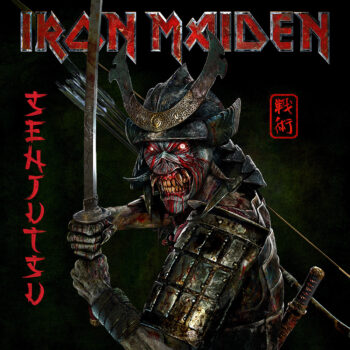
Iron Maiden’s 17th album, Senjutsu hit the streets way back in 2021, and we didn’t review it, not even a little bit. We didn’t get the promo because we are a tiny blog well beneath the notice of Maiden Industries, Ltd., and we just never got around to penning our thoughts in a post-release piece. Call it Chronic Maiden Fatigue Syndrome or institutional malaise, but whatever the cause, we regret missing a chance to weigh in on such a major release. Now we are finally going to set things right and cram our subjective opinions down your throats en masse with an unexpected and extra unruly Rodeö! They say with time comes wisdom, and we’ve had 4 years to consider this mammoth beast feaster, and though all the horses have gone lame waiting for us, we won’t be denied our donkey and pony show! And if you don’t like the results, just remember, YOU asked for this! Ladies and gentlemen, welcome to a VERY special Rodeö.
AMG Himself: Senjutsu is an album burdened by time. The record is long, yes, but more crucially, it is slow and introspective. It dwells on themes of morality, history, and regret with a musical vocabulary that continues to confuse repetition for gravitas. The album’s sense of time manifests most clearly in its extended forms and repetitive structures, where intros and outros bookend nearly every track without adding depth (like “Lost in a Lost World,” “Hell on Earth,” or any solo-composed Harris song since 1994), while variations on the same riffs return with little transformation. Rather than building tension, it plods, and even moments that initially suggest forward motion—like the gallop emerging halfway through “The Time Machine”—feel like echoes rather than true propulsion. There are, of course, songs that start with promise, like “Darkest Hour” with its neoclassical phrasing or “Writing on the Wall” with a strong pre-chorus and solo build. Still, even these tracks feel the weight of time, worn down by repetition and muted by an oddly muffled production. Despite the sheer size of the band and the album’s runtime, Senjutsu rarely delivers on the promise of late-era Maiden. Where Maiden once relied on harmonized thirds and fifths—a sound so Maiden it’s become synonymous with their brand and the entire NWoBHM—they now eschew harmonies. Instead, they almost exclusively opt for octave doubling, flattening their melodic texture instead of enriching it.1 It’s a change that mirrors their relationship with the gallop: a beloved signature that they neglect, used only as a rare and almost self-conscious throwback (by Gers in “Stratego” and “The Time Machine”). Harry’s bass, once the motor that drove their sound, defaults to block chord shapes (“Days of Future Past,” “Lost in a Lost World,” etc.), contributing more to texture than direction. The record’s self-serious tone and funereal pacing skip solemnity and heft, landing right in stagnation. Acoustic intros pile up, disconnected from the songs they introduce, while Bruce’s stripped-down vocal production lays bare the strain on his upper register. Senjutsu presents itself as profound, a statement on a legend’s legacy, but its strengths are buried. Overall, it’s better than Book of Souls, and similarly, there’s a good 45-minute album hidden inside of here! But Senjutsu cannot overcome time itself; not in structure, pacing, or the feeling that it’s caught up with them. 2.0/5.0
Steel Druhm: I had concerns about Senjutsu after hearing lead single “The Writing on the Wall.” It just felt tired. Bruce’s lordly vocals sounded more ragged than they had since those terrible early ’90s live albums, and I worried this might be the best Maiden could do at this point in their career. With Senjutsu running just under 82 minutes, that warned of a whole lotta crap taffy to wade through. Good news first: there are quality moments to be found on this lustily zaftec, completely edit-free atomic bloatbomb. Iron Maiden are too talented to completely shit the bed, so you get modest highpoints like “Stratego,” which reminds me of the better Dance of Death material,2 and “Days of Future Past” which comes out punching, delivers memorable lumps and fucks off, all in under 5 minutes. Then there are the Maidenified cuts that go nowhere and take too long doing so, like “Lost in a Lost World,” which sounds like an AI approximation of a Maiden song that meanders lifelessly for 9 minutes. “The Time Machine” would have fit in on No Prayer for the Dying, so take that as you will. And as much as I’m predisposed to cut Maiden a fuckton of slack, there’s no good reason why the album should conclude with back-to-back-to-back 10-plus minute “epics.” I get that there’s no one in the studio with the clout to tell them when MOAR is too much, but you’d think at least one band member would have pointed out that they were committing excessively bestial overkill. Of these tumefied terrors, “Death of the Celts” fares worst, its supposedly chest-thumping machismo only attaining titty twiddling levels, and man, it just keeps going…right into the next 24 minutes of big and not so beautiful Maidenforms. A good producer would brutally hack all three concluding epics (and spread them out), trim other unsightly bits down, and force this Eddie dumper closer to Good. In the end, Senjutsu is a less entertaining album than No Prayer for the Dying, and you don’t need to be a gambler to place bets on it losing out to Virtual XI in an internet popularity contest. All this hurts to type, but here we are. 2.0/5.0
Grymm: 2021 was a wild, wild time. We were slowly returning to an uncomfortable normalcy after separating ourselves due to pandemic lockdowns and safety precautions. There were not one, but two Batushkas vying for your love (and hard-earned cash). Oh, and Iron Maiden dropped an album that was so massive that we’re just now getting around to reviewing it almost four years later. Sure, they can’t be bought, they can’t be sought, but sadly, they also can’t be told to self-edit because on Senjutsu, we have over 81 minutes of music that could have benefited from some serious trimming. It’s not all terrible, though. While the title track tries (and largely fails, due to its lethargic nature) to conjure up themes of war, its immediate follow-up, “Stratego,” gets the job done right, with its enjoyable guitar hooks and Bruce Dickinson’s catchy vocal melody in the chorus. “The Writing on the Wall” threw me off initially, being a bit too bluesy from what I expect from Iron Maiden, but it’s slowly winning me over years later. The rest of the double album, however, falls into the same trappings that plague modern-day Maiden: namely, long songs padded with synth work, excessive repetition (looking right at you, “Death of the Celts”), and a lack of flow. The fact that three of the four Steve Harris-penned epics are tacked on the tail end of the second album doesn’t surprise me, and it’s these three songs in particular, totaling at over 34 minutes, that could use the most trimming, proving that while Senjutsu’s far from their worst album,3 it’s a far, far cry from their heyday, and one I seldom can (or want to) find time for. 2.0/5.0
El Cuervo: It’s no exaggeration to say that I’ve been a fan of Iron Maiden since the crib. I was raised on a vigorous diet of 70s and 80s heavy metal, of which these Brits occupied the largest part. So why wasn’t I delighted with the opportunity to write about 2021’s Senjutsu? First, I was to be one of many writing about it. Second is Senjutsu itself. It’s well-trodden territory relating to third-millennium Iron Maiden, but the album running for 82 minutes is truly fucking unnecessary. Closing with three tracks running for nearly 35 minutes – and only the first of these (“Death of the Celts”) being remotely good enough – is borderline-criminal. Repetition stretches would-be-good material far too thinly, resulting in a listen that’s only enjoyable in patches. A new decade also saw Bruce’s voice change. It lacks the range and operatic edge for which he is rightly acclaimed, replaced by a bluesy tone that remains solid but less powerful than previously. But despite my incessant gripes with Senjutsu, it’s still impossible to deny the classic Maiden traits that bleed through. The rhythmic triplets, the harmonized guitar attack,4 and the ear for bombastic theatricality in the face of a genre that can be oh-so-serious. Unsurprisingly, the best tracks are the shortest: “Stratego” is close to the galloping, speedy Maiden of olde, while “Days of Future Past” has a groovy swagger that—unlike much of the album—doesn’t outstay its welcome. I’m not yet ready to give up on these genre stalwarts. 2.5/5.0.
Dolphin Whisperer: The induced labor process can take upwards of 72 hours—ripening to dilating to rupturing to pushing to delivering. Yet each section, no matter how arduous, serves a vital purpose toward a thrilling conclusion. Senjutsu doesn’t follow these rules of engagement, though. No stranger to the long cut, Maiden looks to expand and explore their classic, longer form sounds on Senjutsu’s odysseys with riffy aplomb and vocal heroism—a bit shouty for Bruce if we’re being honest, but no more so than Blaze or anything stadium-driven in Maiden’s post-’90s life. Age hasn’t robbed Dickinson of a tune, however, with gargantuan reprisal mic melodies finding full expression after choice, jammy recursions (“Stratego,” “The Time Machine”). Alas, much like one would not wish to witness each crawling minute of a hospital-guided heaving,5 Senjutsu misses the mark of success by unfolding lengthy narratives in a manner that doesn’t captivate consistently. Dickinson’s vocal climb often spends less time building to a furious chorus crescendo than it does competing in volume-loaded blare against walls of low variation, recycled riffage (“Lost in a Lost World,” “Death of the Celts,” “The Parchment” ). And further, Senjutsu pads its epic scope with shrill, simple backing synth layers that place its attempt at progressive craft both too close to late ’80s Maiden superiors to matter and too self-similar to feel like a necessary part of each track. Of course, if you’ve ever suspected that Maiden played slower, louder, and with low-edit epic energy could break your heavy metal water bag, then inhale deeply and prepare for unadvisable durations of pushing. Senjutsu really could have crowned at “Darkest Hour,” but instead we got a whole extra album after that. 2.0/5.0
Maddog: Every new(ish) Iron Maiden release inspires both excitement and apprehension. Senjutsu’s grandiose guitar leads (“Days of Future Past”) and earworm choruses (“The Writing on the Wall”) are a potent reminder of Maiden’s formative role in both metal history and my life. While the band’s expansive classics are impossible to recapture, tracks like “Lost in a Lost World” share the same epic DNA. But although the guitar work remains strong, Bruce’s formidable voice shows signs of wear, and Steve Harris maintains his post-1988 commitment to bland bass lines. As the album progresses, these cracks widen. The second half’s riffs lack Maiden’s signature oomph, like the anticlimactic ending of “The Time Machine.” And Senjutsu isn’t merely long; it feels long, with expendable repetition and infuriating digressions that add nothing, like the ambient beach sounds that bookend “Darkest Hour.” As the unmemorable 11-minute “Hell on Earth” brings the record to a close, I can’t avoid feeling like Senjutsu is a slog. But for a slog, it’s not half bad. 2.5/5.0
Mystikus Hugebeardo: Considering how Senjutsu is usually talked about around the AMG water cooler, you’d think that listening to it would kill you instantly or something. So, imagine my disappointment when Senjutsu turned out to be a perfectly normal visit to the ol’ Iron Maiden. Sure, it’s definitely overlong; the title track and “Lost in a Lost World” are as overwrought as a hair metal musician’s do and could use a helluva trim, and some split ends could be cut entirely (lookin’ at you, “Death of the Celts”). But there’s a lot of really solid material here. Melodies are crafted with the same triumphant vigor of Maiden’s best, clearly heard in the middle-section of “The Time Machine” and much of “Hell on Earth.” “Stratego” and “The Writing on the Wall” are also right bangers, catchy and to the point. Nothing in Senjutsu is radically new or surprising, and full songs can be inconsistently engaging, but Iron Maiden has always had that effortless gallop that draws you in, even in their weaker material. Bruce’s age is showing in his voice, though he sounds solid enough and clearly isn’t just slumming it, while the guitar work of Janick, Dave, and Adrian is still stellar. Honestly, sometimes Senjutsu just feels like set-ups designed to eventually arrive at some sort of excuse for one of the three to just bust out some mind-blowing solo. I’m absolutely here for it, because there’s not a bad solo on Senjutsu, but there’s waaaaaaaaay too much fluff around ’em. 3.0/5.0
Tyme: When the chance to write a blurb for Iron Maiden’s seventeenth llooonnnggg-player Senjutsu came up, I pounced. Full of Maiden staples, the hooves of Harris’ galloping bass lines still run roughshod throughout alongside Nicko’s massive kit work. Great choruses abound (“The Writing on the Wall,” “Days of Future Past”) in consort with thoughtful lyrics admirably delivered by Dickinson, who manages his aging voice well, as Murray, Gers, and Smith illuminate the skies with thundering riffs and lightning solos (“Stratego,” “The Time Machine”). As Maiden enters the final stretch of their runway, Senjutsu still holds up. Whether it’s the refreshingly bluesy swagger of “The Writing on the Wall” or the first two Pink Floydian minutes of “Lost in a Lost World,” it’s evident Harris and company still have a few tricks left up their sleeve. As has been the case with Maiden, though, it’s Senjutsu‘s longest players (“The Parchment,” “Hell on Earth”) that shine brightest. Whether it’s the opening rhythmic strums of the former—approaching slowly like a Tuareg warrior on camelback across sand-strewn horizons—or the heartfelt and touching guitar lines launching the latter, both tracks adhere to Maiden‘s epic song bell curve, ebbing and flowing in waves of everything Iron Maiden does well. Just shy of ninety minutes, however, chunks of Senjutsu would have been better cut with Eddie’s sharp new Samurai sword, the noodlingly bloated “Death of the Celts,” a prime example. Senjutsu didn’t unseat A Matter of Life and Death as my favorite Iron Maiden album of the past 25 years, but it didn’t have to. Because while there’s nothing here I’d call essential, it’s still new Iron Maiden, and that’s good enough. 3.0/5.0
ClarkKent: I know I’m in the minority,6 but I enjoy Senjutsu in all its bloated glory. There’s an undeniable charm to Iron Maiden’s music that is, even 40 years later, uniquely them. In their long career, Iron Maiden has gone through various phases, and this possible swan song is more in line with Dance of Death and A Matter of Life and Death than their earlier classics. If there is one strength Iron Maiden demonstrates on Senjutsu, it’s that they are the masters of the build-up. You can pick almost any song, say “Death of the Celts,” and hear how they use arpeggios to slowly build anticipation, providing release in the form of some killer riffs. Another strength is Bruce Dickinson’s master storytelling. His voice reels you in and hooks you, whether on the adventurous “The Time Machine” or the more melancholic “Darkest Hour.” When he sings, I just want to stop and listen, even if it’s to hear the cadence of his voice. A good storyteller, however, needs to know when to quit. There’s not a single song on Senjutsu that I dislike, yet each could be vastly improved with a few snips. “The Parchment,” for example, has a catchy melody and some riveting riffs, but spends too much time dilly-dallying over stale drums and rhythm guitars while shredding one solo too many. Cut this song in half and you’d have a classic. Even “Days of Future Past,” the tightest song of the bunch, manages to meander. A younger me who spent considerable time with Senjutsu gave it a 3.5 when it first came out. I’m grateful for this chance to again spend considerable time with the album, and in my heart, I still love it, but younger me overrated it. This is a good record that is suffocating a much better one. 3.0/5.0
Ferrous Beuller: My brother and I are huge Iron Maiden fans. And, as with any fan boy, an amount of apologist behavior ensues. Senjutsu, however, is the ground where familial battle lines are drawn. My sibling and I both travel long distances for work. He claims that the one-on-one setting is where Senjutsu comes into its own, where its composite moments can permeate the subconscious with repetition. But, for me, the line between coma and death is just a little too blurred. Senjutsu is an honest reflection of present-day Iron Maiden: muscle memory riffing and second-nature harmonies. And while the decades-honed songwriting remains intuitive to such a metal institution, the electricity feels absent here. The songs are bloated and overlong, as is the album itself. And while mileage may vary somewhat depending on your preference for Maiden‘s writing, having to force an album into your subconscious should never be the key that unlocks the door. Is Senjutsu bad? Absolutely not. Iron Maiden would have to try to create something poor at this point actively. But sonambulence simply must not be a selling point. Check this out and then skip the sleepwalking in favor of more imperiled Dances of Death. 2.0/5.0
Shocking Surprise Guest: Doc Fisting: Like many modern albums by classic bands, Senjutsu suffers from bloated song lengths and an inability to self-edit. Senjutsu contains about 40 minutes worth of good ideas, which happens to be about the same length as Killers. Unlike Killers, though, Senjutsu is 82 minutes long. Predictably, Maiden is at their best when playing with some sense of urgency. “Stratego” is fairly memorable, as is the dusty Old West vibe of “The Writing On The Wall.” “Days Of Future Past” is also worthwhile, sounding like a sequel to the Somewhere In Time era both thematically and musically. The other tracks have some standout moments as well, carried mostly by Bruce Dickinson’s gravitas and the songwriting of people not named Steve Harris. But even Bruce cannot save this album from its SEVEN epic-length tracks. The opening title cut, a slow waltz clocking in at 8:20, kills all momentum on arrival. There’s also three (!!!) 10-minute-plus tracks that appear back-to-back at the end of the record. “Death Of The Celts” is the most unbearable of these, meandering through disjointed intros and transitions that would not have been missed by anyone had they been deleted. Would I like to see Iron Maiden return to writing shorter, more coherent songs? Yes. Is that the end of this review? Also yes. 2.0/5.0
The post Learning Senjutsu at the AMG Rodeö: Putting the New(ish) Iron Maiden Album Out to Pasture appeared first on Angry Metal Guy.